

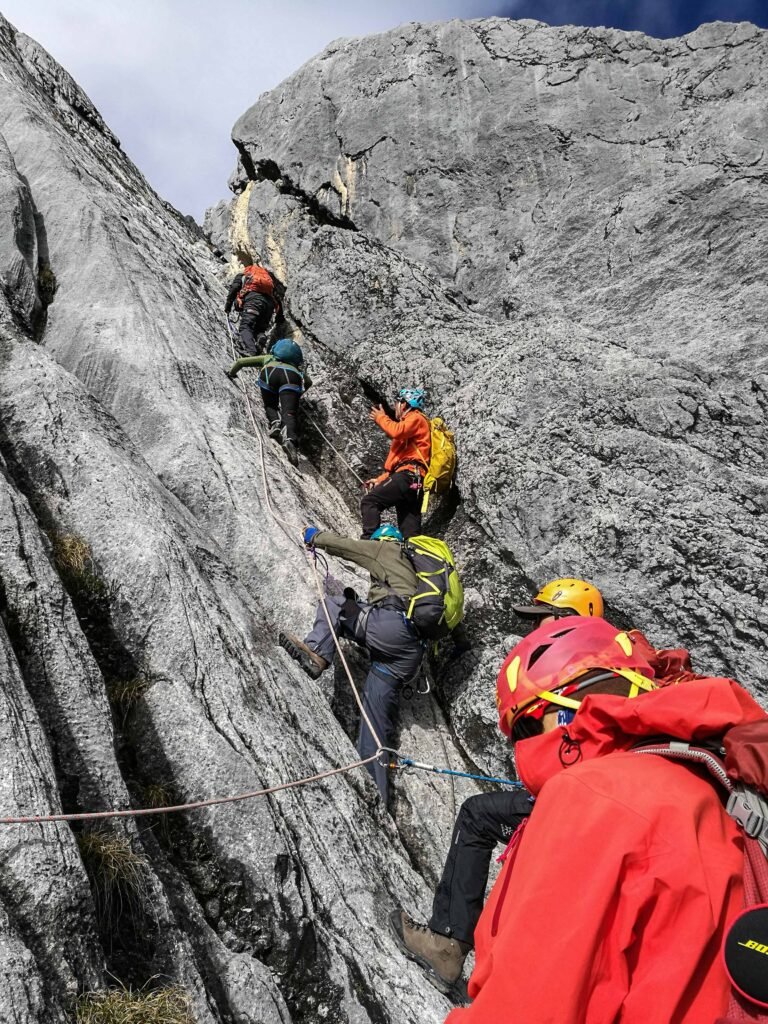
At an altitude of nearly five thousand meters above sea level, there is no room for error. Strong winds blow between the limestone cliffs of the Jayawijaya Mountains, fog descends suddenly, and the sharp rocks of Carstensz Pyramid tower like defensive walls. Here, a rope is not just a tool, but also a lifeline. The safety system known as the fixed rope system is a crucial part of climbing Carstensz. Without the ropes permanently attached to the summit route, this mountain would be nearly impossible to climb safely, even for the most experienced climbers. Unlike other higher mountains that can still be climbed on foot, Carstensz forces climbers to scale its walls. Its limestone walls are steep, fragile, and often slippery due to tropical rains. The route to the summit cannot be traversed on foot; it must be conquered with technical skills.
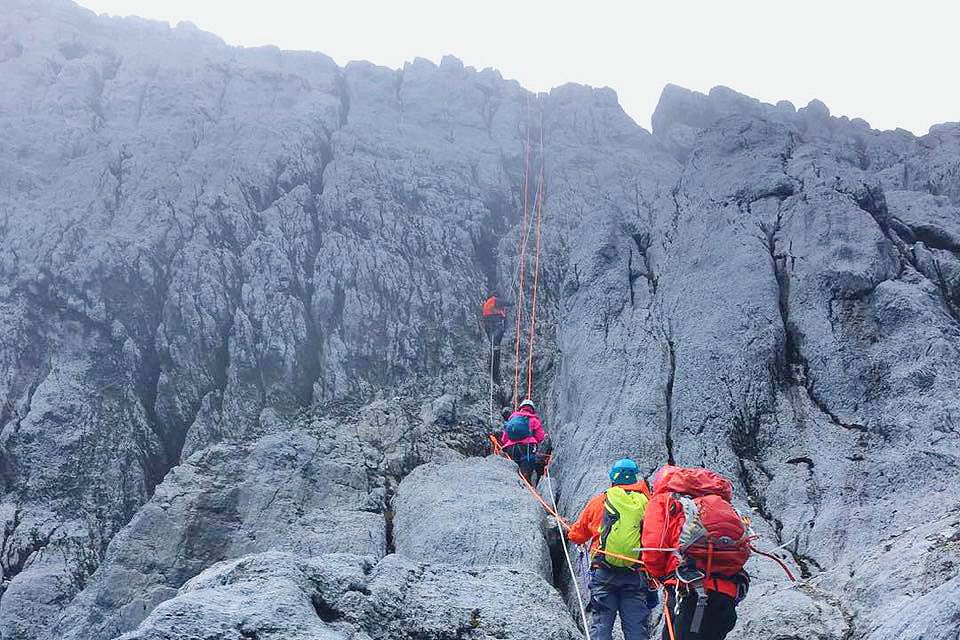
Here, fixed ropes play a very important role. These ropes are installed in the most challenging sections, including the climbing route, narrow paths, steep descents, and famous points such as the Tyrolean traverse. For climbers, these ropes serve as handholds, supports, and protection all at once.
What is a Fixed Rope System?
A fixed rope system is a static rope network that is permanently or semi-permanently installed on technical climbing routes. At Carstensz, these ropes are connected to anchors embedded in limestone, using a combination of bolts, slings, and other safety systems designed to support human weight in extremely harsh conditions. Climbers do not hold onto the ropes directly. They are connected via devices such as jumars, carabiners, and lanyards, which allow them to move up, down, and sideways while remaining attached to the safety system.
In other words, climbers move with the ropes they do not climb the mountain without protection.
On the Carstensz ridge, ropes still serve several key functions. When climbing, climbers use ascenders that are raised with each step. These devices are designed to lock automatically in the event of sudden pressure, preventing free fall. Movement must be slow, steady, and controlled because moving quickly increases the chance of an accident. When descending, the system changes. Climbers use a descender to descend with full control, maintaining speed and body stability. Descending is often more risky than climbing, as fatigue and slippery surfaces can be a dangerous combination. In tyrolean traverses, the rope remains the only route. Climbers rely entirely on the rope system to cross the ravine, with each carabiner double-locked as an additional safety measure.

Many climbers ask, “ why are there no alternative routes without ropes?” The answer to this is clear because Carstensz does not offer such an option.
The characteristics of Nemangkawi limestone make it difficult to find a safe path without vertical protection. Some parts of the ridge are only as wide as a foot, with deep ravines on both sides. In rainy or foggy conditions, without fixed ropes, the risk of accidents becomes much higher. Fixed ropes are not a faster way, but rather a human adaptation to difficult terrain. Installing fixed ropes is not a task to be taken lightly. This activity is generally carried out by a team of expert guides and mountain technicians who know about the nature of the rock, the direction of the load, and the safest location for anchors.
These ropes need to be checked regularly. Exposure to rain, wind, and friction with rocks can reduce the strength of the ropes. In large expeditions, rechecking before making a summit push is a mandatory step. A small mistake in installation or neglecting the condition of the ropes can have very dangerous consequences.
In the early days of exploration, Carstensz was once covered in thick snow. Today, with the decline of glaciers, climbing methods have shifted entirely to rock climbing. The rope system remains a hallmark of this new phase of Carstensz climbing, a phase that emphasizes technique, precision, and great responsibility. These ropes are not installed to conquer the summit, but to facilitate humans to traverse with respect and safety.