

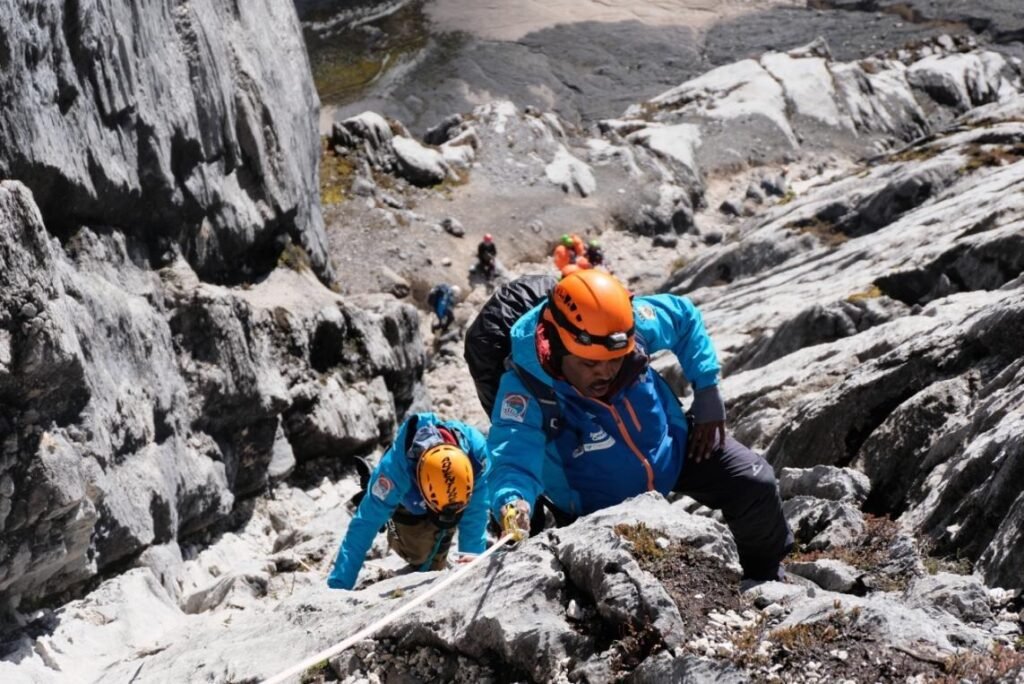
Carstensz Pyramid, also known as Puncak Jaya, is not only the highest mountain in Indonesia but also a world of its own. It brings together the raw beauty of Papua’s wilderness and climbing challenges that truly test a person’s skill and endurance. Standing at 4,884 meters above sea level in the Sudirman Range, Carstensz is the only peak within the Seven Summits that lies in a tropical region. This unique geographical setting gives the mountain a distinct character unlike any other summit in the world.
The terrain on Carstensz is far from the typical hiking trails found on most Indonesian mountains. Here, climbers step into a full rock-climbing environment. Towering limestone walls, steep vertical cliffs, long sloping sections, and narrow rock gaps define the journey to the top. When rain hits, the limestone turns extremely slippery and dangerous. Many sections of the route can only be passed using proper climbing gear such as a harness, carabiners, ascenders, and fixed rope techniques that must be mastered beforehand. At certain points, climbers must cross between cliffs in mid-air using techniques that demand high concentration, precision, and courage.
The weather adds an entirely different layer of difficulty. Although located in the tropics, temperatures on Carstensz can drop drastically, especially at night or when strong winds sweep down from the summit. Thick fog often appears suddenly, limiting visibility to just a few meters. Rain is also a constant companion throughout the expedition. These fast-changing weather conditions require climbers to be well-prepared with the right equipment, from waterproof jackets and insulated gloves to sturdy footwear capable of gripping the slick limestone surface.
Access to Carstensz has its own distinct challenges. Climbers cannot simply go on their own; the expedition requires official permits from local authorities and approval from indigenous communities such as the Dani, Damal, and Moni tribes. Engagement with the local communities is not just a formality but a meaningful part of the journey itself. Especially through the Sugapa route, climbers will pass traditional villages, dense rainforests, swamps, and wide valleys over several days before reaching basecamp. This makes the expedition feel more like a cultural and environmental exploration rather than a simple mountain climb.
Understanding the character of Carstensz is crucial for anyone planning to take on this extraordinary peak. It demands physical strength, technical knowledge, and strong mental resilience. Yet for those who reach the top, Carstensz offers more than a sense of achievement. It delivers lessons about endurance, respect for nature, cultural appreciation, and the unmatched beauty of Papua’s highlands.