

Papua Tengah, Timika — Rising sharply from the dense tropical rainforests of Papua, Carstensz Pyramid stands as one of the most extraordinary mountains on Earth. At 4,884 meters above sea level, this limestone peak—also known as Puncak Jaya—is the highest mountain in Oceania and the only place in the world where climbers can encounter glaciers at the equator.
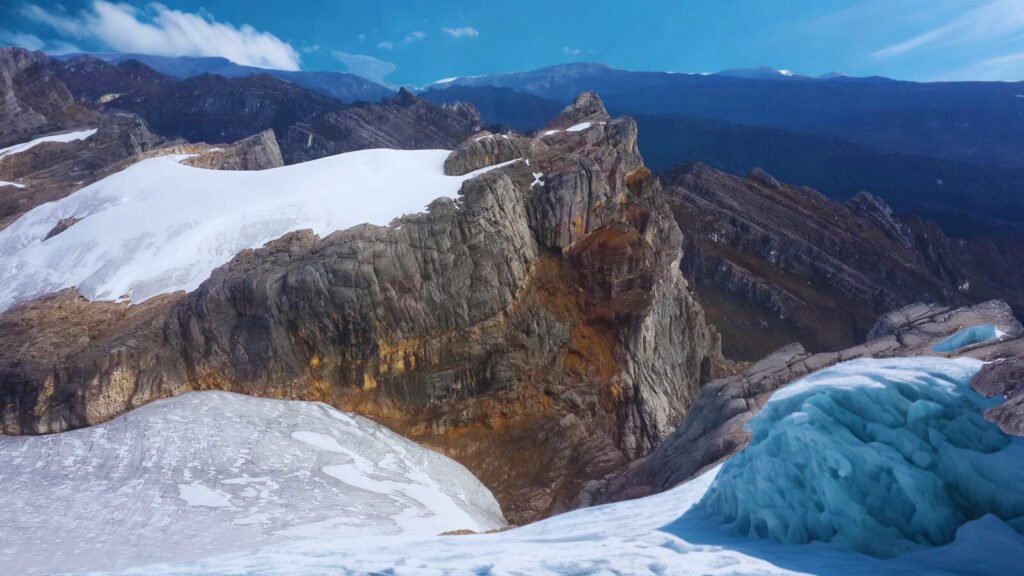
More than a destination for elite mountaineers, Carstensz Pyramid is a geological anomaly, a climatic paradox, and a culturally sacred landscape for Indigenous Papuan communities.
A Geological Outlier in the Tropics
Carstensz Pyramid is composed primarily of massive limestone, a rarity among the world’s highest peaks, which are typically granite or volcanic in origin. Millions of years ago, this region lay beneath a shallow sea. Through tectonic uplift driven by the collision of the Australian and Pacific plates, ancient coral reefs were thrust upward, forming today’s dramatic cliffs and sharp ridgelines.
The result is a rugged karst landscape marked by vertical walls, exposed fossils, and knife-edge ridges—features that demand technical rock climbing rather than traditional alpine snow travel. This geological history not only shapes the mountain’s extreme terrain but also sets it apart from the other peaks in the famed Seven Summits list.
A Climatic Paradox: Ice at the Equator
Despite its location directly beneath the equatorial sun, Carstensz Pyramid hosts the last remaining tropical glaciers in the Asia-Pacific region. These glaciers—once extensive—have been retreating rapidly due to rising global temperatures.
For climbers, this creates an experience found nowhere else: ascending through humid jungle, misty alpine grasslands, exposed rock faces, and finally snow and ice—all within a single expedition. Scientists regard Carstensz as a critical indicator of climate change, as its shrinking ice fields provide visible, measurable evidence of warming in one of the planet’s most remote regions.
A Sacred Mountain in Indigenous Cosmology
For the Moni people, the traditional custodians of the Carstensz region, the mountain is not merely a physical landmark. It is a sacred entity—often described as the “mother” of the land—whose glaciers represent the head of a living body, with rivers flowing as veins into the valleys below.
This spiritual understanding shapes local attitudes toward climbing and resource extraction. Many Indigenous leaders emphasize respect, ritual, and balance, reminding visitors that Carstensz is not an empty wilderness but a homeland layered with meaning, memory, and responsibility.
One of the World’s Most Complex Climbs
Carstensz Pyramid is widely considered one of the most logistically challenging climbs in the world. Political access, unpredictable weather, remote terrain, and the technical nature of the ascent make the mountain far more demanding than its height alone suggests.
Unlike other equatorial peaks, Carstensz cannot be approached casually. Every expedition requires careful coordination, deep local knowledge, and a strong emphasis on safety and environmental ethics.
More Than a Summit
As glaciers retreat and global interest grows, Carstensz Pyramid stands at a crossroads—between adventure and preservation, exposure and protection. For Papua, the mountain represents both a global symbol and a deeply local reality.
To climb Carstensz is not only to test physical limits, but also to encounter a rare convergence of geology, climate, and culture—a reminder that some of the world’s most remarkable places still resist easy explanation. (AC)