

Central Papua, Timika — Few places on Earth offer a journey as geographically dramatic as the route to Carstensz Pyramid. Known locally as Puncak Jaya, this 4,884-meter peak is the highest point in Oceania and one of the famed Seven Summits. Yet what makes the Carstensz route extraordinary is not only its altitude, but the astonishing environmental transition climbers experience along the way — from dense equatorial rainforest to glacial rock and alpine frost.
It is a journey that compresses continents into days.
The Journey Begins in the Jungle
The expedition often starts in lowland villages such as Sugapa or Ugimba, where humid air hangs heavy beneath thick jungle canopies. The first days are defined by mud, river crossings, and the constant rhythm of rainfall. Leeches cling to boots. Boots sink into wet earth. The forest is alive with insects and the distant sound of rushing water.
At elevations between 1,500 and 2,500 meters, climbers move through tropical montane forest. Towering tree ferns and moss-covered branches frame narrow trails carved over generations by indigenous communities. The temperature remains warm, but the terrain demands endurance. Slippery ridges and swollen rivers test balance long before altitude becomes a concern.
Here, the challenge is not thin air — it is relentless humidity, unstable footing, and logistical complexity.
Climbing Into the Clouds
As the route ascends beyond 3,000 meters, the dense rainforest gradually thins. Trees shrink in height. The air cools. Mist begins to dominate the landscape. What was once vibrant green transitions into a muted palette of moss, shrubs, and exposed rock.
This is Papua’s highland zone — a surreal environment where cloud cover can reduce visibility to mere meters. Weather systems shift quickly. Morning sunlight can give way to afternoon storms without warning. The ground, often saturated from frequent rain, remains unpredictable.
At this stage, altitude sickness becomes a real consideration. The body begins adjusting to thinner air, even as climbers continue navigating steep ridgelines and boggy plateaus. The psychological shift is subtle but significant: the jungle feels distant, yet the summit still seems far away.
Entering the Alpine World
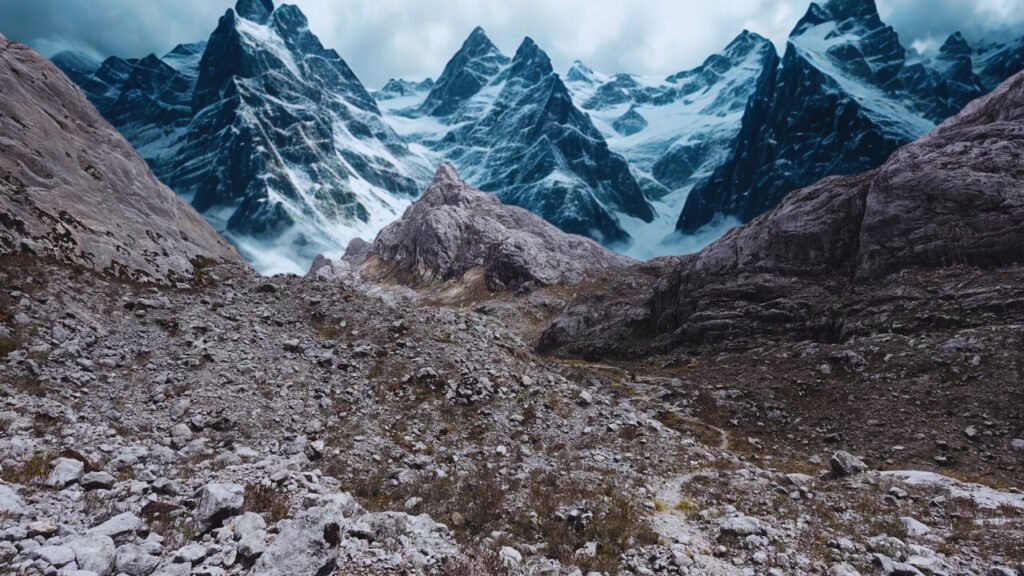
Above 4,000 meters, the transformation becomes dramatic. Vegetation disappears almost entirely. Limestone cliffs rise sharply from barren terrain. Temperatures drop close to freezing, particularly at night. Frost forms on tents at dawn.
Carstensz Pyramid is one of the only places in the world where climbers begin in a tropical rainforest and end on equatorial ice. Though the glaciers have receded significantly over the past decades due to climate change, patches of snow and ice still cling to the upper slopes.
The contrast is stark. Just days earlier, climbers sweated under jungle humidity. Now they layer against cold wind sweeping across exposed ridges.
Technically, the final ascent is demanding. The summit push involves rock scrambling, fixed ropes, and traversing steep limestone faces. The thin air magnifies fatigue. Every movement requires deliberate control.
A Rare Geographic Phenomenon
Globally, few mountains offer such an extreme ecological transition in such compressed distance. In most parts of the world, tropical rainforests and alpine snowfields are separated by latitude. In Papua, they are stacked vertically.
Carstensz stands just south of the equator. Its glaciers exist not because of latitude, but because of altitude. This makes the climb a rare intersection of tropical geography and high-altitude mountaineering.
For climbers accustomed to Himalayan or Andean expeditions, the Carstensz route presents a different kind of test. It is not solely about elevation gain. It is about environmental adaptability — preparing for heat, humidity, heavy rainfall, and then freezing temperatures within the same expedition.
Human Endurance Across Ecosystems
The extreme transition from jungle to ice also highlights the resilience of local highland communities and porters who traverse these routes regularly. They carry heavy loads across muddy valleys and rocky summits alike, bridging ecosystems that seem worlds apart.
Their familiarity with terrain and weather patterns often proves as critical as technical climbing skills. In a landscape where helicopter access can be limited by cloud cover, local knowledge becomes a safety anchor.
A Journey of Contrasts
Reaching the summit of Carstensz Pyramid is undeniably a mountaineering achievement. But the deeper story lies in the passage itself — a vertical expedition through Earth’s climate zones.
Within a matter of days, climbers experience two extremes: the saturated breath of equatorial rainforest and the brittle silence of alpine stone. The Carstensz route is not merely a climb. It is a compressed journey across ecosystems, a reminder of how altitude can redraw geography.
From jungle to ice, the mountain demands adaptability, resilience, and respect. And in that rare transition, Carstensz offers one of the most unique adventure narratives on the planet. (AC)