

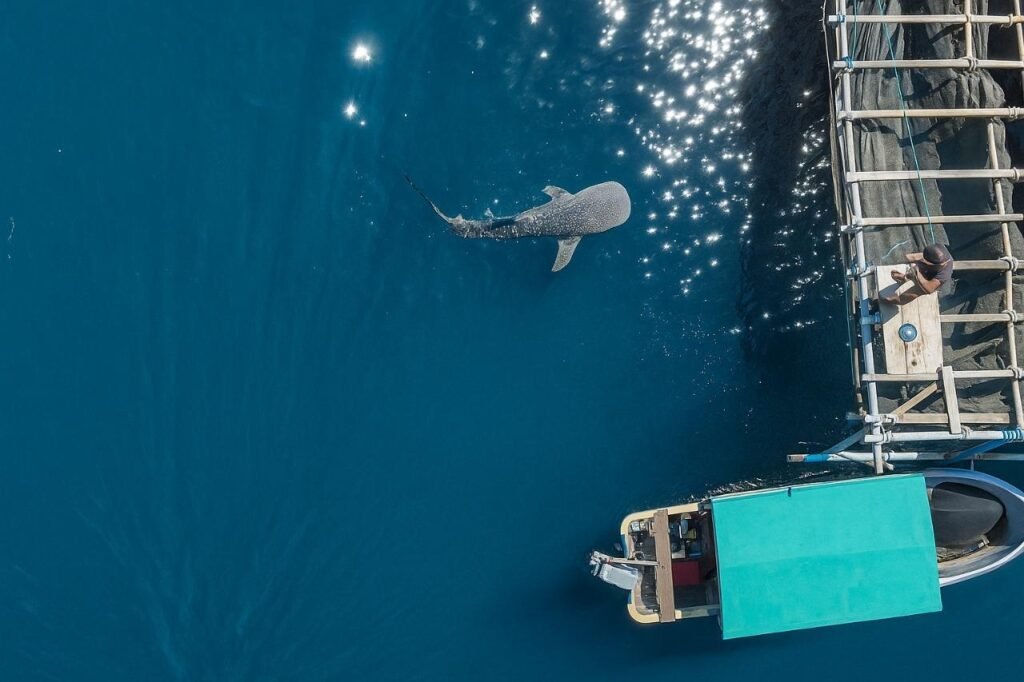
Nabire , Central Papua is famous as one of the marine paradises in Indonesia. Here, live a very special sea creature and an attraction for tourists from all over the world, namely the whale shark (Rhincodon typus). Although called “sharks”, these animals are not dangerous predators, but rather gentle giant sea creatures. Therefore, he is often referred to as “the gentle giant” because of his calm character and is not dangerous to humans. In fact, their presence is an attraction for marine tourism that makes Nabire increasingly known to foreign countries.
Many tourists come with a special purpose: to swim or snorkel with these peaceful sea giants. The experience is described as “dancing” with majestic ancient creatures, as whale sharks have existed for millions of years and have survived as one of the most unique species on our planet. One of the things that makes this whale shark stand out is the white speckled pattern that covers its entire body. This pattern looks like a beautiful and unique natural mosaic, even each individual has a different pattern, similar to a human fingerprint. For researchers, this pattern is valuable because it can be used to recognize and distinguish one whale shark from another. For tourists, this pattern is also a visual attraction that makes the experience of snorkeling or diving with whale sharks feel like swimming next to a giant “living artwork”.
The biggest visual attraction of whale sharks is certainly in its body full of white polka dot patterns. From a distance, the bluish-gray body with white spots looked like a work of art moving in the sea. However, more than just beauty, these polka dots have an important scientific function.
Marine researchers use this pattern as a “natural fingerprint” to identify each individual whale shark, because no two whale sharks with a truly identical spot pattern are exactly alike. For tourists, this makes each encounter feel personal, as if getting to know the unique character of each whale shark encountered.
This polkadot also makes underwater photography activities much more interesting, as the shots show a dramatic combination of giant bodies and elegant natural motifs. It’s no wonder that many travel magazines and marine documentaries have made the Nabire whale shark a visual icon that captivates the world.
In addition to the polkadot, there is one more biological feature of the whale shark that tourists rarely know, namely the lateral line that runs from the tail to the head. This line is not just a decoration, but an important sensory organ that helps whale sharks survive. Through this lateral line, whale sharks are able to detect vibrations, currents, and movements of small organisms around them. In other words, it’s the “natural radar” that makes whale sharks able to find plankton, krill, and small fish—despite their unusually large size.
The body length of a whale shark can reach more than 12 meters, but it survives thanks to its ability to detect food, move and adapt using its incredible sensory apparatus. Interactions with whale sharks in Nabire are not only touristic, but also related to marine conservation efforts.
By understanding the biological uniqueness of whale sharks, such as their speck patterns and lateral lines, we are increasingly aware of the importance of keeping their natural habitat from disappearing. For visitors to Nabire, meeting whale sharks in person will be an unforgettable experience. Not only seeing the largest animals in the world, but also witnessing the incredible beauty of nature and captivating the hearts of anyone who sees it.